You get a video call from your boss. It is her face, her voice, her mannerisms. She needs an urgent payment sent before the end of the day. Everything looks right. The trouble is it might not be her at all.
That is the unsettling reality of deepfakes. They use artificial intelligence to fake a real person’s face or voice, and the technology has gotten good enough that you can no longer trust a video or a phone call just because it looks and sounds real. The good news is that you do not need to be a tech expert to protect yourself. You just need to understand how these fakes work and adopt one simple habit.
What A Deepfake Actually Is
A deepfake is media, usually video or audio, that has been generated or altered by AI to impersonate a real person. Feed the software enough images or a short clip of someone’s voice, and it can produce new footage of them saying or doing things they never did.
A few years ago, this took serious skill and expensive equipment. Today, apps can clone a voice from just a few seconds of audio, often pulled straight from social media. That is why deepfakes have moved from a novelty into a real tool for scams.
Why You Cannot Just Trust Your Eyes Anymore
The old instinct was simple. If you could see someone’s face or hear their voice, you knew it was them. Deepfakes break that instinct.
Scammers use them because they work on trust. We let our guard down when a request seems to come from someone we know. A faked video of a CEO, a cloned voice of a family member, or a polished clip of a public figure all borrow that trust and use it against us.
So, the question is no longer “does this look real.” It is “have I actually confirmed this is real.”
The Warning Signs
Most deepfakes still leave small clues. They are getting harder to spot, but it is worth knowing what to look and listen for.
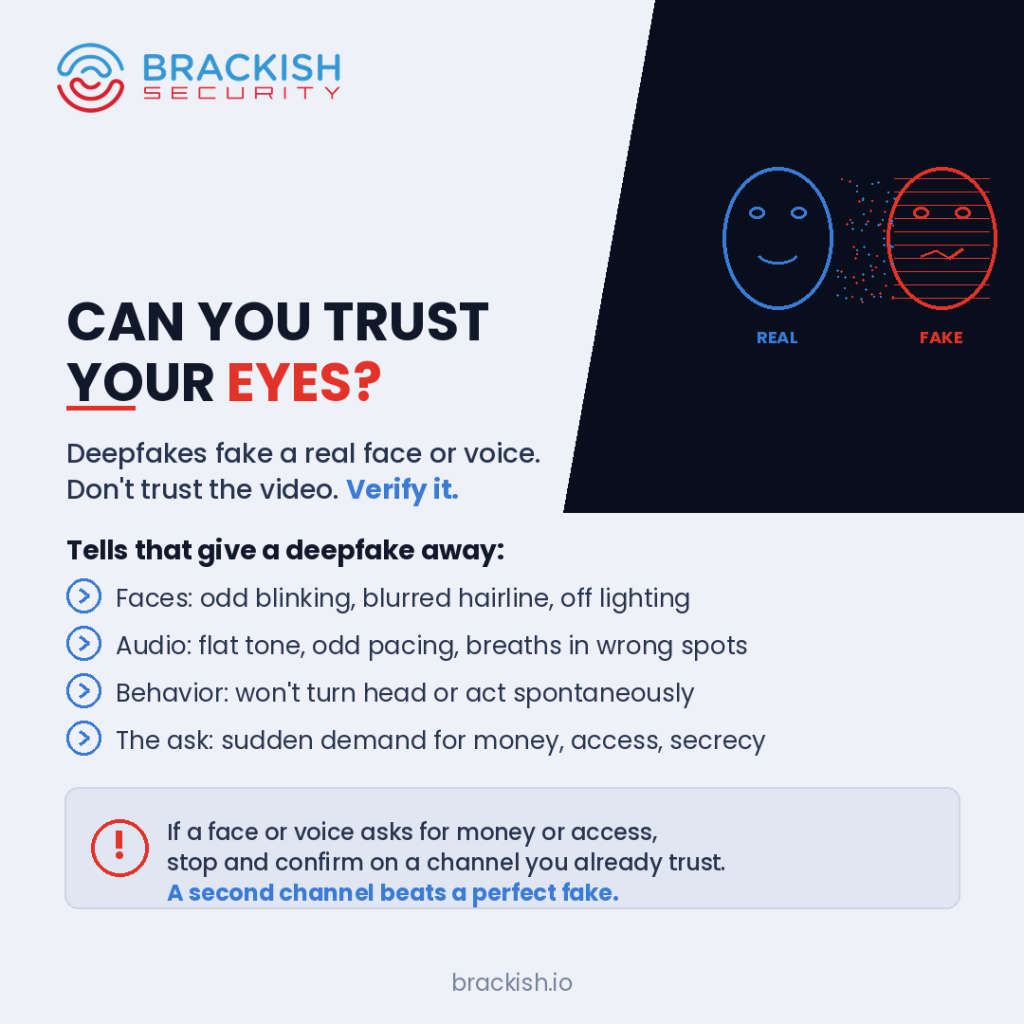
On the visual side, watch for odd blinking, blurring around the hairline or jaw, lighting on the face that does not match the room, and teeth or eyes that look slightly off. Quick or jerky movements can also give it away.
On the audio side, listen for flat or robotic emotion, strange pacing, and breaths that land in unnatural places. A cloned voice often struggles to sound natural in back-and-forth conversation.
On the behavior side, be suspicious of a “live” person who will not turn their head, will not do something spontaneous when you ask, or dodge a simple request to verify who they are.
The One Habit That Beats Almost Every Deepfake
Here is the part that matters most. You do not have to win a staring contest with technology. The single most reliable defense has nothing to do with spotting visual glitches.
Verify through a second channel.
If a video or a call asks you for money, access, or secrecy, stop and confirm the request another way. Hang up and call the person back on a number you already have. Message them on a different app. Walk down the hall and ask in person. A real request will survive that check. A scam usually falls apart the moment you try.
Two simple add-ons make this even stronger. Agree on a code word with your family for real emergencies, so a cloned voice alone is not enough. And never approve a payment or unusual request based on a single call or video, no matter how convincing it looks.
The Bottom Line
Deepfakes are unsettling because they attack something we have always trusted: our own eyes and ears. But the defense is reassuringly old-fashioned. Slow down, stay a little skeptical of urgent requests, and confirm anything important through a channel you already trust. A second channel beats a perfect fake, every time.